Parametric Trigger Monitoring for the ILS Market
Live US multi-peril event feeds with parametric trigger proximity alerts on thresholds you define, the decision each breach forces written on the trigger, and what is live inside each position’s coverage — self-serve and API-first, so a fund manager can put a threshold under watch today without a six-figure contract or a sales call.
$63.9B outstanding cat bond market (Q1 2026). 35 deals in Q1 alone, per Artemis’s Q1 2026 cat bond report. Trigger monitoring has lived inside six-figure enterprise platforms — we make it self-serve and API-first.
What the Desk Sees
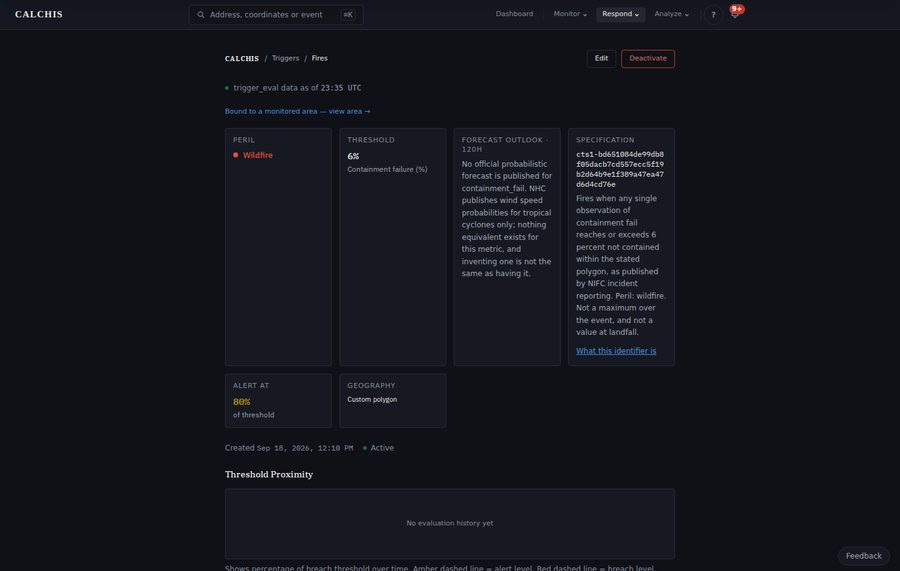
Triggers on Thresholds You Define
Wind speed, central pressure, earthquake magnitude, storm surge, flood stage, containment failure — on a monitored area or a polygon you draw, with an alert level at any percentage of the threshold. Every trigger states the exact observation that fires it: a single reading at or above the threshold inside the geography (at or below, for central pressure), not a maximum over the event and not a value at landfall.
Open Triggers →The Decision a Breach Forces
Each trigger carries the decision its breach forces, in the fund's own words — notify the committee, mark the position, call the broker — and that sentence rides in every breach notice, so the person paged at 03:00 reads what to do, not only what happened.
Write the decision on a trigger →Evaluated Every Five Minutes, With Evidence
Every active trigger is evaluated against the live federal feeds on a five-minute cycle, and each determination records the source observation it rested on. Where no official probabilistic forecast exists for a metric, the trigger says so rather than inventing one; the NHC wind-speed probabilities are used where they exist.
See a trigger's evidence →Live Inside Each Position's Coverage
Give a position its peril and coverage region — a state list, a FEMA region, the market's usual names — and the dashboard lists the live events inside that coverage for that peril, forecast products flagged as forecasts. A watch, not an exposure assessment: no attachment point is compared and no loss is estimated.
Open the ILS Dashboard →The Catalog, and What It Can Honestly Evaluate
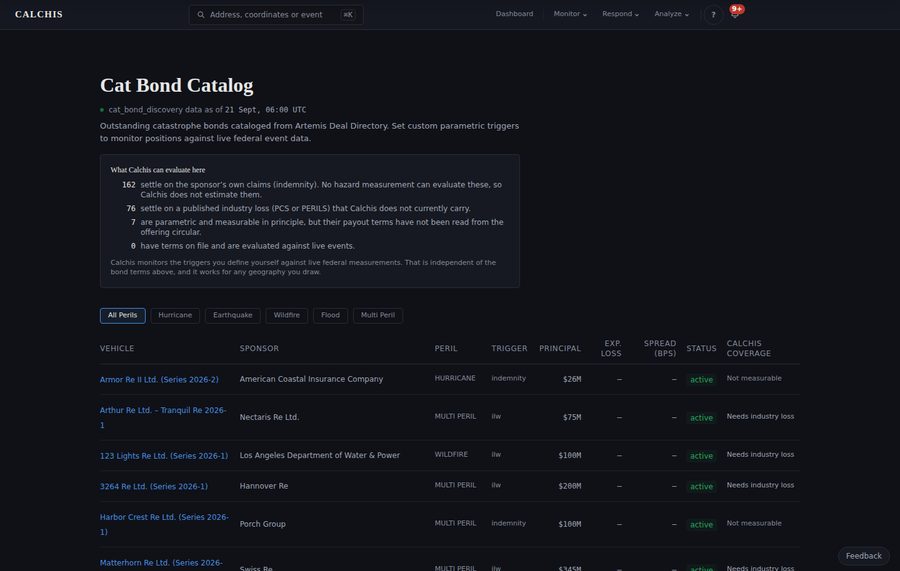
Cat bonds from the Artemis Deal Directory (updates currently paused), each marked by whether Calchis can evaluate it: indemnity bonds cannot be measured by any hazard feed, industry-loss bonds need PCS or PERILS, which are not carried, and a parametric bond is evaluated only once its payout terms are read from the circular.
Open the Catalog →Webhooks, API, Morning Brief
An email to you the moment a trigger approaches or breaches, on every plan; breach notices by webhook from Analyst and to any confirmed email integration; 10 triggers on Analyst and 500 on Team, the public API for the event feed and trigger history, and a morning portfolio brief for a desk.
Set up webhooks →Try It Before Lunch
- Four-step setup — a position, a threshold under watch with the decision a breach forces, the notices, and what the dashboard will tell you. Evaluated on the next five-minute cycle.
- Add a position — peril, notional, coverage region; the dashboard then says what is live inside that coverage.
- Read the API — the same event feed, triggers and history over REST; and the help center — 29 walkthroughs written from the product, 7 of them with captioned video.
USGS (5 min) · NOAA NHC (30 min) · NWS flood alerts (10 min) · NOAA SPC (5 min) · NASA FIRMS (15 min) · NIFC (12 h)
Start with 3 free triggers and 10 tracked positions. Analyst adds webhook alerts, full API access and modeled loss estimates; Team adds seats, the morning brief and OED export; Institutional removes the limits on an annual invoice.
In March we wrote that most cat bonds use parametric triggers. They do not: of the 238 bonds in our catalog, 4 do. The correction is the point. The modeling agent works before the event and the calculation agent after it; a fund manager holding a parametric position decides in the hours between, from broker emails. What a public federal feed can and cannot say in that window.
PCS says average annual U.S. severe thunderstorm losses rose from about $4 billion to over $40 billion, and Verisk is breaking its industry loss index down to county level so county-scale bonds can be priced. A county emergency manager's jurisdiction and an index bond's coverage are the same polygon. What we hold at that resolution today, from the federal record, and what we do not.
Twelve Securis expects capital inflows and a quiet catastrophe year to push January 1 rates down, and says the job for managers is to tell normal repricing apart from a deterioration in the risk itself. The distinction is a data problem. Repricing is one number everyone can see. Deterioration hides in attachment points, covered perils and subject-business definitions that almost nobody reads after the deal closes. Of the 238 cat bonds in our catalog, we hold a published attachment point for none.
Swiss Re Institute puts the premium opportunity from AI data centers and renewable energy at $200 billion between 2026 and 2030, and sees a role for cat bonds and sidecars in the upper layers of the towers. The catch is where the assets are. Data center exposure is the least diversified property book in the world, solar and wind farms sit in the hail and convective belts, and the capital above the tower will need to price the hazard site by site.
The catalog lists 238 bonds from the Artemis Deal Directory. Updates are paused, and maturity dates are not on file, so newer bonds are missing and some listed bonds may have matured. By trigger structure: 161 indemnity, 73 industry-loss, 4 parametric.
Bond-level trigger proximity is not published today. Proximity is only honest for parametric wind structures, where “percent of threshold” means something; on an indemnity or industry-loss bond the same number would be a guess wearing a decimal point. None of them currently carries a structure confident enough to model, so the engine is built, validated against wind, and withheld rather than pointed at bonds it cannot honestly price. When that changes, this paragraph changes with it.
What runs today is trigger monitoring on thresholds you define — wind speed, central pressure, magnitude, surge, gauge stage, containment — against the live event feed, on a five-minute cycle, with an evidence snapshot at breach. That path is independent of the catalog and does not wait on it. How a trigger is determined, and Hurricane Milton replayed through three triggers.
What Calchis is not. Industry-loss bonds settle on an estimate published by PCS or PERILS, which are licensed and not integrated here; Calchis carries no industry-loss number, derived or otherwise, and will not offer that threshold type until it carries a licensed one. Calchis is pre-attachment situational awareness on live public event data — not a settlement source, and not a substitute for the reporting agency your bond names.
ILS fund managers · Cat bond structurers · Reinsurance brokers · Parametric product teams · Cedant cat modelers